Hey everyone! If you’re doing a diploma or engineering in Computer Engineering or Information Technology, awesome choice! But let’s be real for a second. Looking at job descriptions with words like “Frontend,” “Backend,” “DevOps,” and “Data Scientist” can feel like trying to read a foreign language. It all leads to one big, confusing question: What are the different types of jobs in IT industry? If you’re tired of just nodding along, you’re in the right place. Let’s break it down.
Don’t worry, we’ve all been there! The IT world is HUGE, and it’s way more than just “coding.” Think of it like a massive superhero team—every hero has a different power, and they all work together to save the day. The question is: which hero do you want to be?
Let’s break down the most popular IT career paths in simple, no-nonsense language, so you can figure out where you fit in.
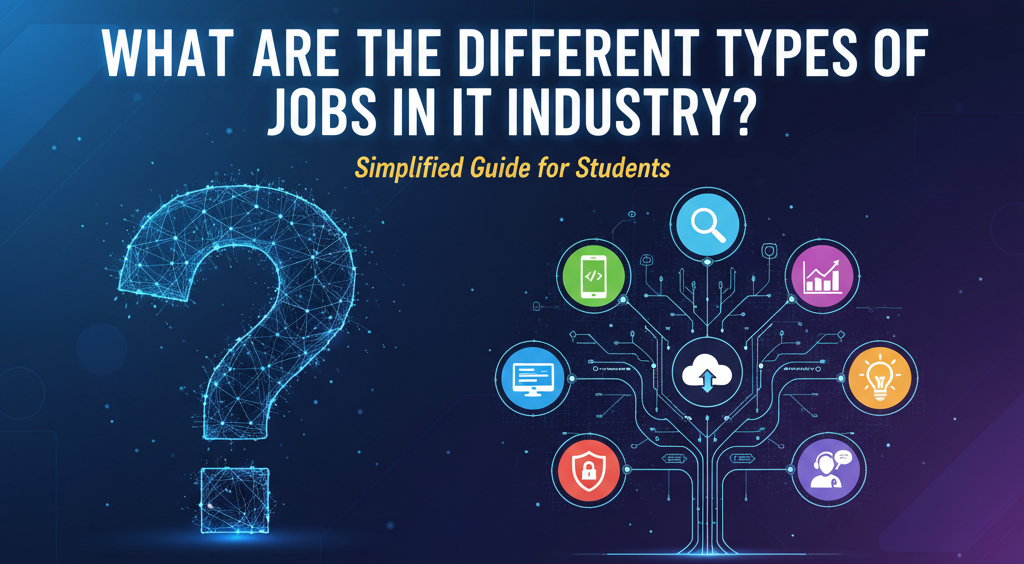
💻 The Builders: Software Development & Engineering
These are the people who actually build the apps, websites, and software you use every day. If you love creating things from scratch, this is your zone.
- Frontend Developer: You’re the artist! You build everything a user sees and interacts with on a website—the buttons, the menus, the cool animations. If it looks good and feels smooth, a frontend developer made it happen.
Your Superpowers: HTML, CSS, JavaScript (and its cool sidekicks like React or Angular). - Backend Developer: You’re the mastermind behind the scenes. You build the “brain” of a website that the user doesn’t see. The database, the server, the logic that makes everything work? That’s all you.
Your Superpowers: Python, Java, Node.js, and the magic of databases (SQL). - Full-Stack Developer: You’re the Iron Man of the group—you can do it all! You’re comfortable building both the beautiful frontend and the powerful backend. Companies love Full-Stack devs because they’re so versatile.
- Mobile App Developer: You build the apps that live on our phones. Whether you’re creating the next big thing for an iPhone (iOS) or an Android device, you’re putting your creation directly into people’s hands.
Your Superpowers: Swift (for iOS) or Kotlin/Java (for Android).
📊 The Detectives: Data & Artificial Intelligence
Do you love finding patterns, solving puzzles, and making predictions? The world of data is calling your name. Data is the new gold, and these are the people who know how to find it.
- Data Analyst: You are the storyteller. You take messy, confusing data, clean it up, and turn it into beautiful charts and reports that help a company make smart decisions. You answer the question, “What does all this information mean?”
Your Superpowers: SQL, Excel, and visualization tools like Tableau or Power BI. - Data Scientist: You’re like a fortune teller, but with data! You use advanced math, statistics, and machine learning to predict the future. “Which customers are likely to leave?” “What movie should we recommend next?” A Data Scientist figures this out.
- Machine Learning / AI Engineer: You are the one who gives software a “brain.” You build the smart systems that power things like Netflix recommendations, voice assistants (like Alexa), and even self-driving cars. You’re literally building the future.
🎨 The Artists: Design & User Experience (UI/UX)
If you have an eye for design and a passion for making technology easy for humans to use, this is your field. It’s not just about making things look pretty; it’s about making them feel amazing to use.
- UI (User Interface) Designer: You are the visual stylist. You decide the colors, fonts, and layouts of an app or website. Your job is to make the first impression a great one.
Your Tools: Figma, Adobe XD. - UX (User Experience) Designer: You are the psychologist. Your main goal is to make a product easy, logical, and enjoyable to use. You think about the user’s entire journey and ask, “Is this simple? Does it make sense?”
☁️ The Architects: Cloud & DevOps
Ever wonder where all the websites and apps actually live? They live in “the cloud.” These are the people who build and manage that digital world, making sure everything runs smoothly 24/7.
- Cloud Engineer: You are the manager of massive, powerful computer systems hosted by companies like Amazon (AWS), Google (GCP), or Microsoft (Azure). You make sure that apps have the power they need to run without ever crashing.
- DevOps Engineer: You are the ultimate team player, connecting the “Builders” (Developers) with the IT infrastructure. Your job is to create automated systems that let companies build, test, and release software super fast and reliably.
🛡️ The Guardians: Cybersecurity
Love the idea of being a digital superhero? Cybersecurity experts are the defenders of the internet, protecting companies and users from hackers and threats.
- Cybersecurity Analyst: You are the security guard on duty. You monitor computer networks for suspicious activity, investigate security breaches, and protect the company’s data from being stolen.
- Penetration Tester (Ethical Hacker): This is one of the coolest jobs ever. You get paid to legally hack into a company’s systems. Your mission? To find weaknesses and security holes before the bad guys do.
🧑💼Management & Strategy (The Leaders)
These roles are less about hands-on coding and more about vision, planning, and leadership. They bridge the gap between the technical teams and the business goals, ensuring that everyone is working together to build amazing and successful products.
- Product Manager: You are the “captain of the ship.” You are responsible for the overall vision of a product. You decide what to build, why to build it, and work with all the teams—from engineering to marketing—to make it a reality.
Read: What is product Management In Detail. - Project Manager: You are the master organizer. While the Product Manager decides the “what,” you are responsible for the “how” and “when.” You create timelines, manage budgets, and ensure that the project is completed on schedule.
- IT Consultant: You are the expert advisor. You work with different companies to help them solve their biggest challenges using technology. You analyze their problems and recommend the best software, strategies, and solutions to help them succeed.
So, which role got you the most excited?
Don’t feel pressured to know your exact path right away. The best part about an IT career is that all these fields are connected. Start with what interests you the most, build a strong foundation with a kick-ass final year project, and never stop learning. Your diploma is the launchpad—now it’s time to decide which planet you want to explore first! Good luck!