What if your next package arrived from the sky, carried by a drone instead of a delivery person on a bike? That future is closer than you think. While we won’t see a sudden, massive switch, the shift is already starting. Drone delivery in India will likely begin with high-priority deliveries for companies and hospitals, and over time, it will change how we all get our packages. In this post, we’re going to discuss status of drone delivery in India. We’ll look at the awesome possibilities, the really tough challenges, and what it all means for our future.
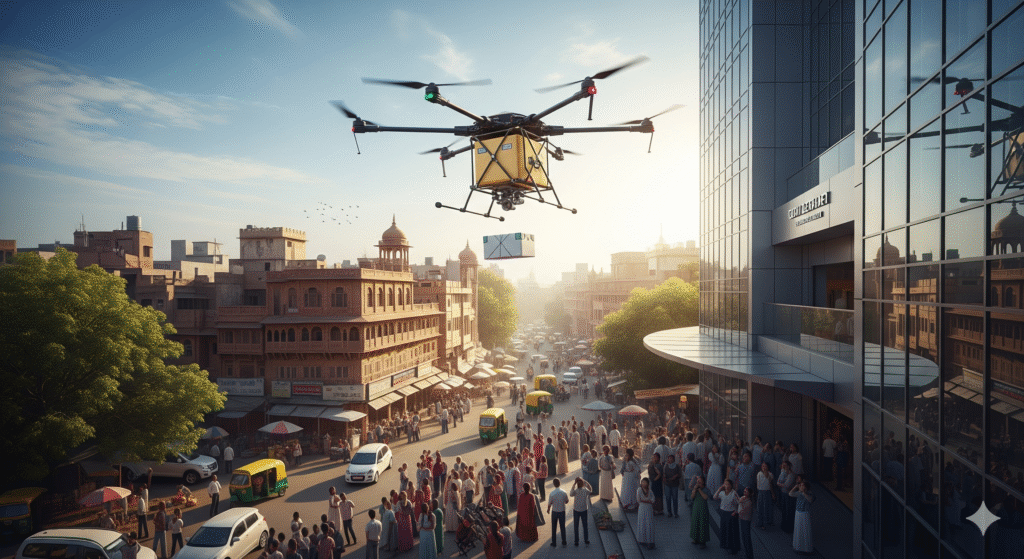
Imagine this: You’re in college, lectures are about to start, and you realise you’ve forgotten your tiffin at home. But what if, in just a few minutes, a drone buzzes to your college gate carrying your delicious, home-cooked meal? All because someone from your family dropped it off at a local drone station and set your college location. Sounds like something from a sci-fi movie, doesn’t it? Well, it might seem impossible now, but it’s closer than you think and could become a reality within the next few years.
1.Government’s Green Signal for Drones
Until 2021, the rules for flying a drone in India were very complicated and strict, which significantly slowed down innovation. However, that all changed when the government completely revamped its approach by launching the new and much simpler ‘Drone Rules, 2021‘, designed to boost the entire drone industry.
Read the press release here.
What this means in simple terms:
- No Pilot License Needed: The requirement for a drone pilot license was completely removed! Now, a simple certificate from an authorized flying school is enough, and you don’t even need a 12th-grade pass for it.
- Digital Sky Platform: An easy-to-use, single-window online map now shows where you can and can’t fly drones. It has opened up nearly 90% of India’s airspace as a “green zone” where no permission is needed to fly up to 400 feet.
- Boosting ‘Make in India’: This is a huge focus. The government has banned the import of foreign drones and started a Production-Linked Incentive (PLI) scheme to encourage companies to build drones and their parts right here in India.
- Support for “Drone-As-A-Service”: An initiative called “Drone Shakti” was announced to help startups that offer services using drones, making the technology more accessible to various industries.
2.Who is Actually Flying Drones in India Today?
It’s not just talk; companies are already running pilot projects across the country. Here’s a look at the key areas:
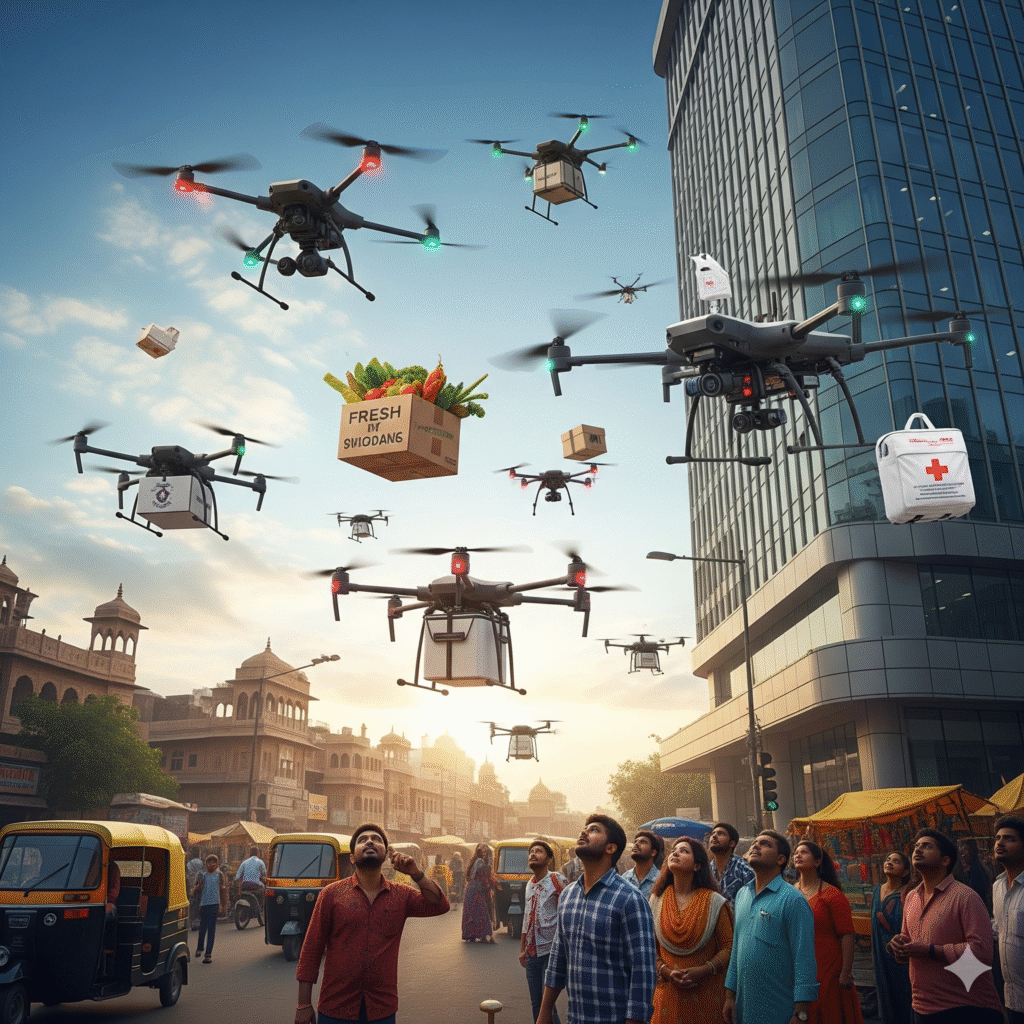
- Healthcare’s High-Fliers: This is where we’re seeing the most action. Drones are delivering emergency medicines, vaccines, and blood samples to remote villages in states like Telangana, Meghalaya, and Uttarakhand. It’s literally a lifesaver!
- E-commerce and Groceries (The Urban Trials): In cities like Gurugram and Bengaluru, startups like Skye Air are testing grocery and package deliveries from warehouses directly to residential complexes, beating the city traffic.
- Mail from the Sky: You might be surprised to hear that India Post has successfully tested drone delivery for mail and parcels in Gujarat, cutting down a journey of hours to just under 30 minutes.
- Help in Hard Times (Disaster Relief): The National Disaster Response Force (NDRF) is using drones to deliver food, water, and first-aid kits to areas cut off by floods or landslides.
3.Why Isn’t a Drone Delivering Your Pizza Yet?
If the rules are simple and tests are happening, what’s the hold-up? Here are the big challenges we still need to solve:
Managing the Sky Traffic: How do you control thousands of drones over a city without them crashing into each other? We need a dedicated air traffic control system for drones. Think of it like a digital traffic police, telling drones where to fly and how to stay clear of each other.
Safety and Security: Drones must be safe. What if a drone gets hacked and someone tries to steal the package? Or what if a motor fails and it falls out of the sky? Public safety is the number one priority, so we need strong anti-hacking tech and reliable safety features like parachutes.
India’s Tough Weather: Drones are lightweight. They can struggle with our country’s heavy monsoon rains and strong winds. A strong gust of wind could blow a drone off its path. We need to build tougher, all-weather drones that can handle these conditions.
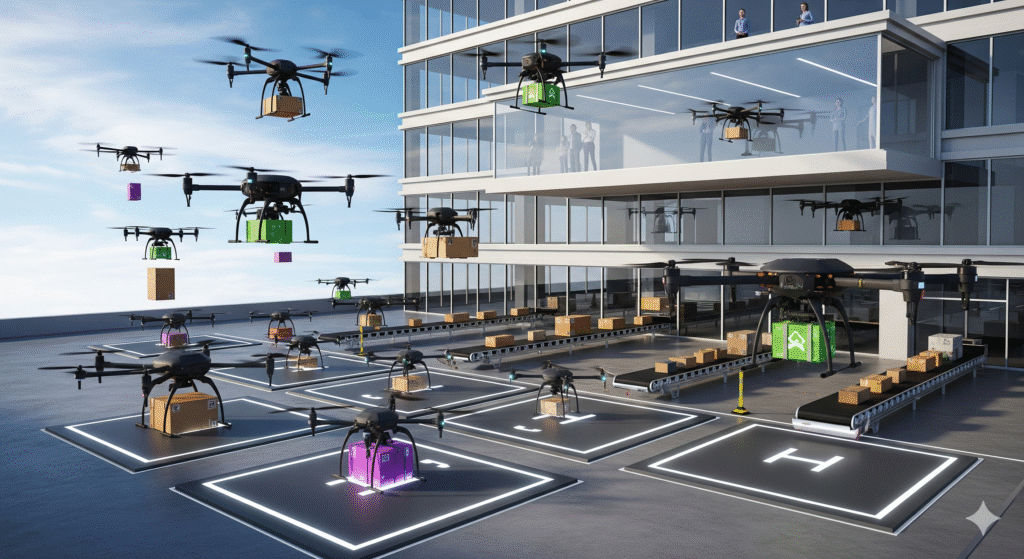
The “Last 50 Feet” Problem: This is the final, trickiest part of the delivery. A drone can easily fly to an apartment building, but how does it safely deliver a package to a specific 10th-floor balcony without hitting wires, windows, or people? This requires special solutions like smart landing pads or automated delivery boxes.
4.The Big Question: What Happens to Jobs?
Will delivery riders lose their jobs? This is a major concern. It’s true that some traditional delivery jobs for small, quick packages might be replaced by drones in the long run.
But new tech creates new jobs: History shows us that technology creates more jobs than it destroys. This will be a shift, not a dead end. We will need a whole new workforce with new skills. For example:
- Drone Pilots & Operators: People to monitor and control fleets of drones from a central command center.
- Drone Mechanics: Skilled technicians to repair, maintain, and inspect the drones to keep them flying safely.
- Drone Station Staff: People to manage the loading of packages, swap batteries, and handle the logistics at the drone hubs.
- Software Developers: Coders and engineers to build and improve the air traffic systems, the drone software, and the delivery apps.
Conclusion:
So, what’s the final status? Drone delivery in India has officially moved from a dream to a work-in-progress. The government is supportive, the technology is being tested, and the potential is huge.
The bottom line: While widespread, everyday drone delivery for your shopping is still a few years away, specialized services in healthcare and emergency logistics are already becoming a reality. The foundation is being laid, so keep your eyes on the skies!