Introduction
Ever since humanity set its foot on this planet and explored the world around, there have been incessant efforts put to make transportation faster, better, and more convenient to people worldwide. Over the span of ages, various new modes of transportation like automobiles, airplanes, high-speed trains etc., came into existence with time. However, there always is a scope of innovation; to reach greater speeds than the ones already achieved by utilizing lesser energy.
In this regard, hyperloop is the most progressive system thought of revolutionizing transport to achieve that goal; in this technology, passengers are transported within levitating pods that glide through low-pressure sealed vacuum tubes at extreme speed; reportedly over a1000 km/h.
The technology plans on minimizing the aerodynamic drag and friction to cut energy waste & ultimately achieve highest sped while utilizing least energy compared to conventional modes of transport. Hyperloop combines both air as well as rail transport; to ensure highest ease and speed simultaneously to passengers at much affordable price and less travelling time. The hyperloop would utilise the basic engineering principles based upon mechanical engineering, control engineering, civil,electrical and aerospace engineering to come up.
Basic Working Principle:-
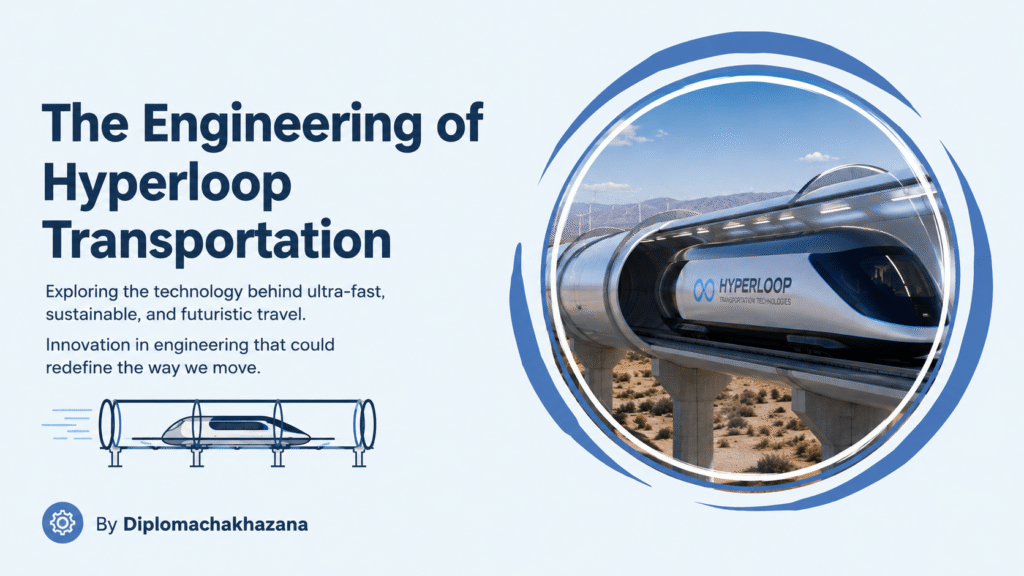
Hyperloop system can be broadly said to comprise of three essentialcomponents of the machine to be utilized. Those components are of three categories namely;the low-pressure tube, a vehicle (the pod), and a mechanism used to motivate thepod at higher speeds.
The Hyperloopposits a pod which is carried to a low-pressure (vacuum) tube from which it draws air out to minimize the pressure to almost nothingness to diminish aerodynamic drags.
With the reduction in drag,thepodmoves at speeds near that of an Airplane.
Thepod does notmove on tracks butlevitates from one part of a guide to another, for instance electro magnetic principles or a similar mechanism called the’air-bearings‘. The linear-electric-motor is used to speed-up and slow-down the pod so it doesn’t travel to and fro violently inside tube and reach desired speed, without any physical contact of a guide to the car to produce and remove torque;it just accelerates it and deceleration and to control its movement through the tube.
Low-Pressure Tube Engineering:-
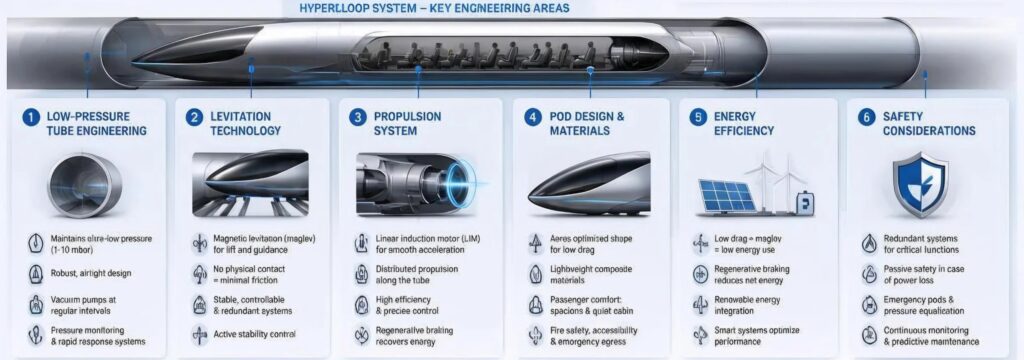
The tube plays perhaps the most important role in Hyperloop, as without this component the whole idea would not be possible.
Aerodynamic drag force increases drastically with speed, which causes conventional high-speed trains to lose speed due to air resistance forces acting upon them to slow down the moving object or part. In addition, at an ordinary speed of ~50 mph this drag is significant.
The Hyperlooptube aims at significantly reducing this aerodynamic drag at great speed by evacuating almost all the air from the tube creating near vacuum thus creating near perfect stream line conditions for the travellingpod without it disturbing the internal environment of tube.
Thus structural integrity has a significant role to play with standing an external atmospheric pressure on internal near vacuum.
MaterialSelection of tubes requires Careful Analysis of the strains on the structure under the differential Pressure and tensile strains under axial loading and the effect of external loads imposed such as wind, seismic, snow etc on the structure is vital to its design and stabilityMoreover, The vacuum pressure needs be maintained in the tube to be effective and leak proof which means that regular maintenance of the air pumps present along the entire pipe for maintaining low pressure as required is very necessary to keep hyperloop operational at high speeds,as leaks can cause the air inrush causing drag & inefficiency.
Levitation Technology:-
One great improvement made by designing hyperloop transportation methods;removing of the wear and tear that occurred to wheel as compared to normal train and elimination of rolling resistance caused to them due to roadfriction.
The principle of maglev consists of magnets used to levitatethe pod above tee guide without physical contacts thus reducing frictional drag significantly to achieve higher speed at less energy requirements.
In most designs projected by various companies, the rare scanner magnets on top of a vehicle that interacts with electromagnetic coils or stationary guide ways running underneath the Pod’s chassis to create repelling or lifting magnetic fields thereby lifting and centeringthe podin a precise manner in the middle of the tunnel.
Nevertheless, sustaining an accurate and stable levitation at speed approaching sound or even above seems to remain one of the utmost challenging jobs for engineering specialists.
Such technologies must be employed to maintain precisely the distance between the guide way and the pod for avoiding contact during its motion without the levitation mechanism having to cope too much for that.Hence advanced dynamic control system with appropriate sensors to monitor as well asto provide accurate signal to adjust and control its position is a must.
Propulsion System:-
The primary component to boost the speed of the pod in Hyperloop would be a linear motor which will bring forward and hold up by electromagnet forces; hence making it a non- contact propulsion.
It is a electric motor which when placed parallel to the road in many of its variants, generates linear motion (either horizontal or vertical). InHyperloop, linear/electric motors will be placed either alongside the beam or below the pod.
This motor works by having stators fixed along the guideway’s periphery, which excite a time varying magnetic field;This oscillating magnetic force pulls and pushes the on-bard electromagnets mounted on the vehicle’to accelerate and decelerate it in a controllable manner.
This non-contact driving system has many significant merits, it minimises wear and tareon parts. It has energy efficiently(most energy from static components), reduced maintenancecost; moreover,it gives control system to speedup and slows down the vehicle at specific accelerations or to just maintain the speed.
Engineers will need to ensure accurate control for smooth acceleration,deceleration and maintenance of constant speed while taking in to the account passengers comfort.
Pod Design and Materials:-
Hyperloop pods are the passenger cabins or cargo trailers that will travel through low-pressure tubes. Design of this will require consideration to aerodynamics (even though the pressure is less, some air is present), its internal structure, weight and even its external structure in addition to passenger comfort and safety .
Light weighted but strong materials would indeed be required like carbon fibre composites or advanced aluminum alloys to improve acceleration, reduce wear & tear and decrease energy consumption and thus, the number of linear motors required.
The interior ergonomics also be given utmost importance to provide for an optimal riding experience at high speeds .
It requires smart designing with a focus on making it resistant to vibration and with enough room for a good experience of passenger.
Furthermore, the interior environment in the capsule be managed so that there are optimal atmospheric conditions available for a comfortable ride, along with advanced and fast emergency response systems including fire protection mechanisms and well-structured ventilation in case the need arises, in such isolated low pressure environment.
Energy Efficiency and Sustainability:-
One of the primary driving forces behindHyperloop is its potential for vastly improved energy efficiency compared to existing modes of transport. By travelling at high speed in a low-pressure tube with magnetic levitation, energy consumption due to aerodynamic drag and friction is reduced dramatically.
Many design proposals include plans for integrated renewable energy sources, such as solar panels that stretch along the length of the tube, which can not only generate electricity for the hyperloop but also sell any excess energy to the grid.
It is predicted that this technology can significantly reduce overall transportation-related carbon emissions and help shift to more sustainable alternatives for movement and logistics purposes.
Also, energy can be recycled through regenerative braking in which speed energy is conserved and stored.
Safety Considerations:-
For any rapid transit system, safety has to be given the first priority. Due to the presence of vacuum in the tubes and relatively higher speeds than any conventional transit method there may appear a number of risks if the designing not done properly. Any failure in the vacuum maintenance could let air rush into the system creating large friction that can cause malfunction.
So is the case with structural damage of tube that will cause air in-rush causing high pressures;which needs to be prevented and also handled with care.
Moreover the on-board safety during journey is as important as during normal movement of pods.
Engineers must ensure thereare effective evacuation procedures in the event of failure or accident and provide adequate safety to the passengers inside the confined tube of hyperloop. The communication between vehicle pods and ground control station need to be constant, Reliable and automated for smooth operation.