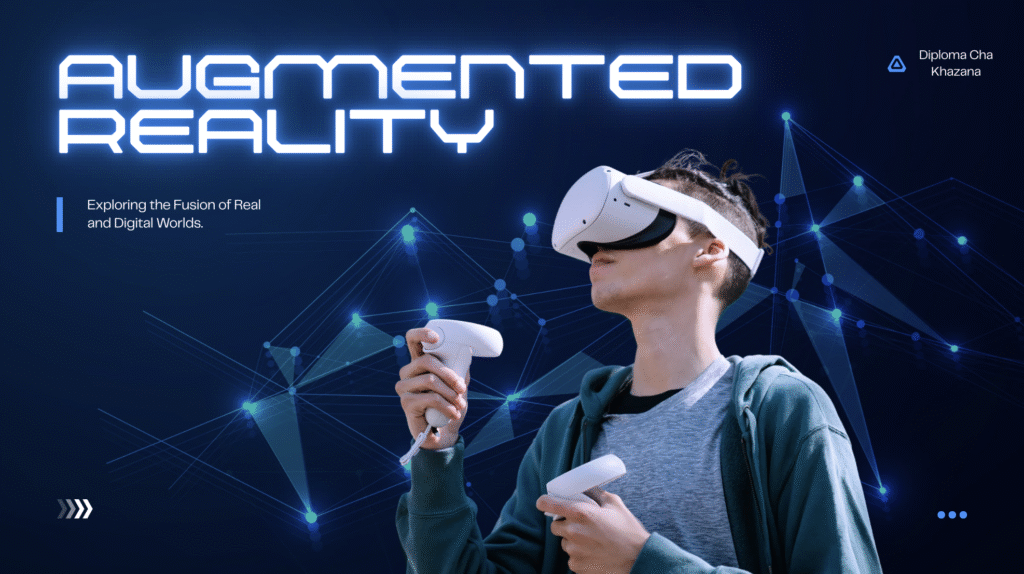
Have you ever pointed your phone’s camera at your surroundings and seen something appear on your screen that isn’t actually there? Maybe you’ve used an Instagram filter that puts digital effects on your face, played a game where virtual objects appear in your room, or used an app that lets you see how a piece of furniture would look in your house before buying it. These experiences might look like something from a science-fiction movie, but the technology behind them already exists. It is called Augmented Reality, or AR. Augmented Reality is a technology that adds digital information, objects, images, or effects to the real world. Instead of completely replacing your surroundings with a virtual environment, AR keeps the real world visible and adds a digital layer on top of it.
This is what makes AR different from Virtual Reality. In Virtual Reality, you are usually placed inside a completely digital environment where the real world is hidden from you. With AR, you can still see the physical world around you while digital content is added to it. Your phone, tablet, smart glasses, or another device uses cameras and sensors to understand what is around you and then displays virtual content in a way that makes it appear as though it exists within your surroundings. The technology is already being used in gaming, shopping, education, healthcare, navigation, engineering, and many other areas, and its applications could become much more advanced in the future.
How Does Augmented Reality Actually Work?
At first, AR might seem like a simple camera effect, but there is actually quite a lot happening behind the scenes. An AR application needs to understand the environment around you before it can accurately place digital objects within it. Your device’s camera captures information about your surroundings, while sensors such as the accelerometer and gyroscope help the device understand how it is moving and how it is oriented. Some devices can also use depth sensors to understand how far objects and surfaces are from the camera.
The software processes all of this information to identify things such as floors, walls, tables, faces, and other objects. Once the system has a better understanding of the environment, it can place digital content within it. For example, if an AR furniture application detects the floor in your room, it can place a virtual sofa on that floor. As you move your phone around, the software continuously tracks your movement and the environment so that the sofa appears to remain in the same physical position. This is why you can walk around a virtual object, move your phone closer to it, or look at it from a different angle while it still appears to be part of your surroundings.
AR Is More Than Just Filters
One of the easiest ways to understand AR is through social media filters. Applications can recognize your face and place digital glasses, masks, makeup, ears, or other effects on top of it. When you move your head, the digital object moves with you, creating the impression that the virtual object is actually attached to your face. These filters are a simple and entertaining example of AR, but they represent only a small part of what the technology can do.
AR can also be used to place digital objects on physical surfaces, provide directions, display information about objects, assist workers, help students understand complicated concepts, and support doctors and engineers. The basic idea remains the same: the technology understands something about the physical environment and then adds useful digital information to it. Instead of treating the physical world and the digital world as two completely separate things, AR attempts to connect them.
AR in Gaming
Gaming is one of the areas where Augmented Reality became particularly popular. A famous example is Pokémon GO, where players use their smartphones to find and interact with virtual Pokémon that appear to exist in real-world locations. The game combines the phone’s camera, location information, sensors, and software to create an experience where the physical and digital worlds overlap. Instead of sitting inside a completely virtual environment, players walk around the real world while interacting with digital content.
The idea behind AR gaming is much bigger than simply putting a character on your camera screen. The environment around you can actually become part of the game itself. A park, street, building, or even your own room can become a part of the experience. As AR technology improves, developers can potentially create games where virtual objects understand the environment around them and interact with real-world surfaces and objects in increasingly realistic ways.
AR in Shopping
Another useful application of AR is online shopping. Imagine that you’re looking for a new sofa but aren’t sure whether it will fit into your living room. Instead of simply looking at a photograph on a website, an AR application could allow you to place a virtual version of the sofa in your actual room using your phone’s camera. You could walk around it, view it from different angles, and get a better idea of what it might look like in your space before making a purchase.
The same concept can be used for furniture, home decorations, clothing, glasses, and other products. By allowing customers to visualize products before purchasing them, AR can make online shopping more interactive and potentially reduce uncertainty about what a product will look like in the real world. Instead of asking customers to imagine how something might fit into their environment, the technology can give them a digital preview using the environment they are already in.
AR in Education
Augmented Reality could also change the way students learn. Some subjects are difficult to understand simply by looking at a textbook or a flat diagram. Imagine studying the human heart and being able to see a three-dimensional model of it floating above your desk. You could rotate the model, examine different parts, and understand how those parts are connected. The same idea could be used for subjects such as anatomy, engineering, physics, chemistry, geography, and history.
For example, an engineering student could potentially use AR to examine a 3D model of a machine and understand how its components fit together. A history student could view a digital reconstruction of an ancient building or city. Instead of only reading about something or looking at a picture, students could interact with a digital representation while remaining in the physical classroom. AR isn’t necessarily meant to replace teachers or textbooks, but it can provide another way of visualizing concepts that are difficult to understand through traditional learning methods.
AR in Navigation
You may also encounter AR while navigating. Traditional navigation applications display a map on your screen and tell you where to turn, but AR navigation can take this idea a step further by displaying directions directly over the camera view. Instead of simply seeing an arrow on a map, you could point your phone down a street and see a digital arrow indicating exactly where you should walk.
To make this possible, the application combines information about your location with information from your device’s camera and sensors. The system attempts to understand where you are and what direction you are facing so that digital directions can be placed within your surroundings. This could be particularly useful in places such as large airports, shopping centres, college campuses, or unfamiliar cities, where looking at a traditional map can sometimes be confusing.
AR in Healthcare
Healthcare is another area where AR has interesting possibilities. Doctors and medical students can use digital models to understand anatomy and visualize information that might otherwise be difficult to interpret. Instead of studying a flat image of an organ, students could potentially examine a three-dimensional representation and understand its structure from different angles. This could make medical education more interactive and help learners develop a better understanding of complex structures.
AR could also potentially assist doctors and medical professionals by displaying useful information while they work. Rather than constantly looking away at a separate screen or reference material, certain information could be displayed within their field of view. While these applications are still developing and require careful testing, healthcare is one of the areas where AR could eventually provide significant value because it can combine physical environments with digital information.
AR in Engineering and Industry
AR isn’t limited to smartphones, entertainment, or education. It can also be useful in workplaces, particularly in engineering and manufacturing. Imagine an engineer repairing a complicated machine. Instead of constantly checking a manual, they could use AR glasses that display instructions directly over the machine. The system could highlight which component needs to be removed and show the next step of the repair process, allowing the worker to access information without constantly switching between the physical task and a separate computer.
Factories and industrial companies can similarly use AR for training, maintenance, assembly, and remote assistance. A new employee could potentially learn how to operate a machine through digital instructions displayed directly in front of them, while an experienced technician could remotely guide another worker by marking specific parts of a machine. This could make AR particularly useful in situations where workers need information while keeping both hands available to work on physical equipment.
What Devices Can Run AR?
You don’t necessarily need an expensive headset to experience Augmented Reality. Modern smartphones and tablets already contain many of the cameras and sensors required for basic AR experiences. This is why AR filters, games, shopping applications, and other experiences can work directly on devices that people already own. Your phone is already capable of understanding aspects of its surroundings, tracking movement, and displaying digital content on top of the camera feed.
However, another category of devices is becoming increasingly interesting: AR glasses and smart glasses. Instead of holding your phone in front of your face, these devices could potentially display digital information directly within your field of view. Imagine walking through a new city and seeing navigation directions in front of you, looking at a machine and seeing information about it, or receiving useful notifications without having to take your phone out of your pocket. This is one of the reasons AR is considered an important emerging technology. The long-term idea isn’t necessarily to make people constantly hold their phones up, but to make digital information feel more naturally connected to the world around them.
What Is the Difference Between AR, VR and MR?
AR, VR, and MR are often confused because they all involve digital content and technology that interacts with our perception of the world. Virtual Reality, or VR, creates a completely digital environment. When you put on a VR headset, you are typically placed inside a computer-generated world where the physical environment is no longer the primary thing you see. Augmented Reality, on the other hand, keeps the real world visible and adds digital elements to it.
Then there is Mixed Reality, or MR, which can be thought of as a more advanced interaction between the physical and digital worlds. Digital objects aren’t simply displayed over the real world; they can interact with and respond to the environment in more sophisticated ways. The boundaries between these technologies can sometimes overlap, but the basic distinction is useful: VR replaces your environment, while AR adds to it, and MR aims to create a more interactive relationship between physical and digital objects.
What Are the Challenges of Augmented Reality?
Despite its potential, AR still has several challenges to overcome. One of the biggest is hardware. A good AR experience requires cameras, sensors, displays, processing power, and software that can all work together quickly. If there is even a small delay between your movement and the movement of a digital object, the experience can feel unnatural. Battery life is another challenge because continuously using cameras, sensors, displays, and powerful processors can consume significant amounts of power.
There are also privacy concerns. AR devices may constantly use cameras and sensors to understand their surroundings, which raises questions about what information is being collected, where it is stored, and who has access to it. There is also the question of whether people actually want to wear AR glasses throughout their daily lives. For AR to become truly mainstream, the technology needs to be comfortable, useful, affordable, and socially acceptable, not just technically impressive.
What Could the Future of AR Look Like?
The future of Augmented Reality could be much more interesting than simply putting virtual objects on your phone screen. As hardware becomes smaller and more powerful, AR could become less dependent on smartphones. Lightweight glasses could potentially provide directions, notifications, translations, reminders, and contextual information without requiring you to constantly look down at a screen.
Imagine looking at a restaurant and seeing information about it appear in front of you, travelling to another country and seeing translated signs, or looking at a machine and seeing an interactive explanation of how each component works. An engineering student could potentially look at a piece of equipment and receive step-by-step instructions, while a tourist could explore a historical site and see digital reconstructions of what the location looked like hundreds of years ago. Some of these ideas are still being developed, but the overall direction is clear: technology is gradually moving toward making digital information more connected to the physical environment.
The World Around You Could Become Interactive
Augmented Reality is ultimately about changing the way we interact with technology. For decades, we have mostly interacted with computers through screens. We look at a display, click buttons, type commands, and move through digital menus. AR introduces another possibility: what if the world around us could become part of the interface?
A table could become a surface for a virtual model. A machine could display its own instructions. A street could show navigation information. A classroom could contain interactive three-dimensional models. Instead of constantly switching between the physical world and a screen, digital information could eventually become a natural part of the environment around us.
That is what makes Augmented Reality more than just a collection of camera filters and games. It represents a future where the boundary between digital information and the physical world becomes less obvious. The next time you point your phone at your surroundings and see something digital appear on your screen, remember that you’re not just looking at an effect. You’re seeing an example of technology trying to connect the digital world with the real one — and that could be one of the most important ways we interact with computers in the future.