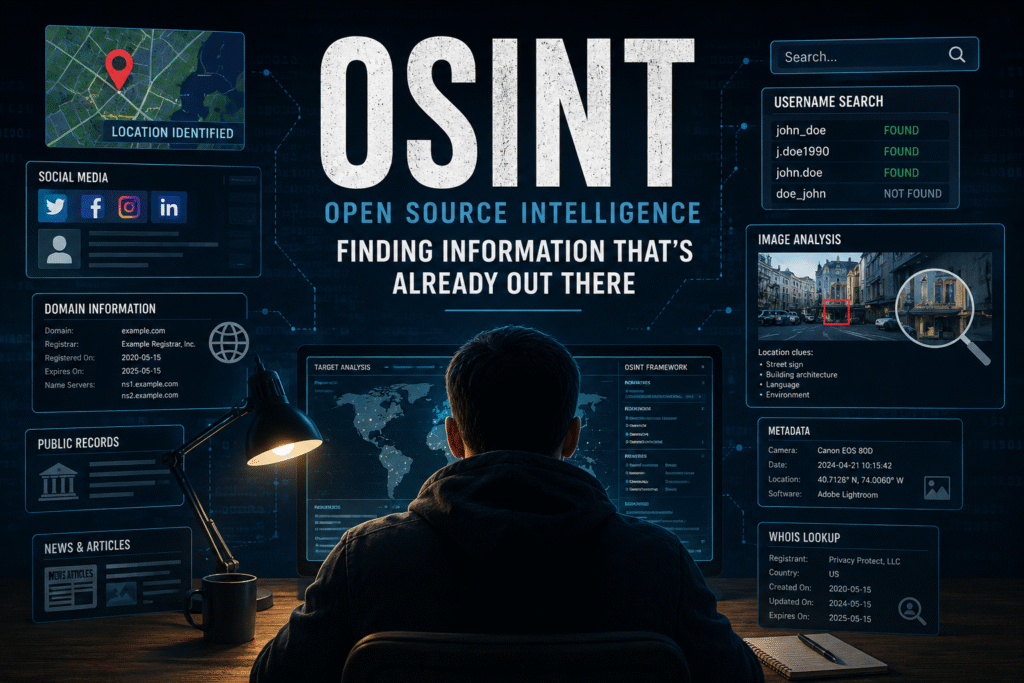
Imagine you are trying to find out who owns a particular website, where an old photograph was taken, or whether an online profile is genuine. You don’t necessarily need to hack anything or gain access to private accounts. In many cases, the information you need may already be available somewhere on the internet. The challenge is knowing where to look, what to search for, and how to connect different pieces of information. This is where OSINT, or Open Source Intelligence, comes in.
OSINT is becoming increasingly important in cybersecurity, journalism, law enforcement, business, and even everyday online investigations. It involves collecting and analyzing information from publicly available sources to understand a person, organization, website, event, or situation. But what exactly makes information “open source,” and how do investigators turn random pieces of information scattered across the internet into something useful? Let’s understand how OSINT technology works in simple terms.
What Is OSINT?
OSINT stands for Open Source Intelligence. The term sounds complicated, but the basic idea is quite simple. OSINT means collecting useful information from sources that are publicly accessible and then analyzing that information to answer a specific question.
For example, imagine a cybersecurity analyst wants to understand a company before performing a security assessment. They might look at the company’s official website, public social media accounts, domain information, job postings, technical documentation, and other publicly available sources. None of this requires breaking into the company’s systems. The analyst is simply collecting information that the company or other public sources have already made available.
The word “intelligence” is important here. OSINT isn’t just about finding information. It is about turning publicly available information into useful knowledge. Finding a company’s LinkedIn page is information. Discovering that the company recently hired several employees for a particular technology and uses that technology across its infrastructure is a more useful piece of intelligence.
How Does OSINT Work?
An OSINT investigation usually starts with a question. Instead of randomly searching the internet, an investigator first decides what they are trying to find. The question could be something like “Is this website legitimate?”, “Who operates this organization?”, or “Where did this photograph come from?”
Once the goal is clear, the investigator searches through different public sources. They might begin with a search engine and then move to social media, websites, public databases, news articles, images, domain records, or other sources. The important part is that information from one source can lead to another.
Suppose you find a company’s website and notice an email address listed on its contact page. That email address might lead you to the company’s social media accounts. Those accounts could reveal employee names, which could lead to public professional profiles. Those profiles might mention technologies or projects associated with the company. Each individual piece of information may seem unimportant, but connecting them can provide a much clearer picture.
This process of collecting, verifying, and connecting information is what makes OSINT powerful.
Where Does OSINT Information Come From?
The internet contains an enormous amount of publicly accessible information, and OSINT investigators can use many different sources. Search engines are one of the most obvious starting points because they index websites, documents, news articles, images, and other online content.
Social media is another major source. Public posts can reveal information about companies, events, locations, projects, and professional activities. Public professional profiles can also provide information about someone’s job role, skills, education, or organization.
Websites themselves can provide valuable information. Investigators can examine public pages, company announcements, technical documentation, job listings, and other content. Domain registration information and DNS records can sometimes provide additional clues about a website’s infrastructure, although privacy protections can limit what is publicly visible.
Images and videos can also become important OSINT sources. A photograph may contain visual clues about its location, time, or origin. Reverse image search can sometimes help identify where an image appeared previously or whether an image has been reused in a different context.
Public government databases, court records, company registries, academic publications, news archives, and other publicly accessible databases can provide additional information depending on the investigation.
How Do Investigators Find Information Using OSINT?
Finding useful information isn’t always as simple as typing a question into Google. OSINT investigators often use carefully constructed searches to narrow down results.
For example, searching for a common name may return thousands of unrelated pages. Adding an organization, location, profession, or another keyword can significantly reduce the number of irrelevant results. Search engines also support advanced operators that can help users search specific websites, file types, phrases, or parts of a webpage.
However, good OSINT isn’t just about knowing search operators. The quality of the investigation depends on the questions you ask. An investigator needs to think about what information should exist, where it might appear, and how different pieces of information could connect.
This is why OSINT involves both technical skills and logical thinking.
OSINT and Social Media
Social media has become one of the biggest sources of publicly available information. People and organizations voluntarily share an enormous amount of content online, including photographs, locations, professional updates, event announcements, and opinions.
For an OSINT investigator, these posts can provide useful context. For example, if a company announces that it is attending an event, public posts from employees or the event organizers may provide additional information about when and where the event took place.
Usernames can also sometimes help connect publicly available accounts across different platforms. If the same unique username appears on multiple public websites, an investigator may be able to determine that the accounts are connected. However, a matching username alone is not proof that all accounts belong to the same person. Investigators need to verify information using additional evidence instead of jumping to conclusions.
This idea of verification is one of the most important parts of OSINT.
How Can Images Be Used in OSINT?
Images can contain far more information than what appears at first glance. A photograph may show buildings, road signs, landmarks, weather conditions, vehicles, languages, or other visual clues that can help identify where or when it was taken.
One common technique is reverse image search. Instead of searching for an image using words, an investigator provides an existing image and looks for visually similar or previously published versions online. This can help determine where an image originally appeared or whether someone has reused an old photograph and presented it as something new.
Metadata can sometimes provide additional information as well. Some images may contain data such as the device used to capture the photograph, the date it was created, or location information. However, many social media platforms and messaging services remove or modify metadata when users upload images, so it should never be treated as guaranteed evidence.
What Is Geolocation in OSINT?
One particularly interesting part of OSINT is geolocation, which means determining where a photograph or video was captured.
An investigator may examine a picture and look for clues such as road signs, building designs, mountains, street layouts, language, traffic signs, or even shadows. These clues can then be compared with publicly available maps and satellite imagery.
For example, suppose you find a photograph showing a road with a unique building in the background. You might identify the language on a sign, determine which countries use that road-sign design, and then compare the building with locations visible on online maps. Several small clues can eventually point toward one likely location.
This demonstrates an important OSINT principle: one clue may not tell you much, but several independent clues can tell you a lot.
OSINT vs Hacking
A common misunderstanding is that OSINT and hacking are the same thing. They are not.
OSINT focuses on publicly available information, while hacking generally involves gaining access to systems, accounts, or data in ways that may be unauthorized. Searching a company’s public website for information is OSINT. Attempting to access its private database without permission is not.
This distinction is particularly important for students who are interested in cybersecurity. Learning OSINT does not mean learning how to break into someone’s account. Instead, it teaches you how to investigate digital information responsibly and understand what information an organization or individual is exposing publicly.
In fact, cybersecurity professionals often use OSINT before conducting security assessments because publicly exposed information can reveal potential risks without touching the target’s internal systems.
What Are Some Common OSINT Tools?
There are many tools designed to make OSINT investigations faster and more organized. Search engines are among the most basic tools, but investigators can also use specialized platforms for domain information, DNS records, public data, usernames, images, and other sources.
Tools such as Google Lens can help analyze images, while services such as WHOIS databases can provide publicly available domain registration information when available. Security-focused platforms can also help researchers discover information about internet-facing infrastructure.
However, tools don’t automatically turn someone into a good OSINT investigator. A tool may produce hundreds of results, but the investigator still needs to determine which results are relevant, verify them, and understand their context.
This is why learning the fundamentals of searching, verification, critical thinking, and digital privacy is often more valuable than simply memorizing a list of OSINT tools.
Where Is OSINT Used?
OSINT has applications across many different industries. Cybersecurity teams use it to understand an organization’s publicly exposed information and identify potential risks. Before performing a security assessment, researchers may investigate public domains, subdomains, technologies, employee information, and other exposed details.
Journalists also use OSINT to verify claims, investigate events, and locate the origins of photographs and videos. Law enforcement and intelligence organizations can use publicly available information as part of investigations, subject to applicable laws and procedures.
Businesses can use OSINT for competitive research and threat intelligence. They may monitor public information about competitors, emerging technologies, security threats, or changes in their industry.
Even ordinary internet users can use basic OSINT techniques. For example, before purchasing something from an unfamiliar website, you could research its domain, company information, reviews, social media presence, and online history to determine whether the website appears trustworthy.
A Simple OSINT Example
Let’s imagine you receive a suspicious message from an unfamiliar company claiming to offer you a job. Instead of immediately trusting it, you decide to investigate.
You start by searching for the company’s name. You find an official website and a LinkedIn page. The website says the company has been operating for five years, but its domain appears to have been created only recently. You then search for the company’s employees and discover that several of the names mentioned on the website don’t appear anywhere else online.
None of these clues automatically proves that the company is fake. However, they give you reasons to investigate further. You could search for news articles, company registration information, employee profiles, and other independent sources to determine whether the claims are genuine.
This is OSINT in practice. You are not hacking the company. You are simply collecting publicly available evidence and checking whether different pieces of information make sense together.
Is OSINT Legal?
OSINT itself generally involves information that is publicly accessible, but that doesn’t mean everything you can find online can be used however you want. Laws, privacy regulations, website terms, and other rules can affect how information may be collected, stored, and used.
There is also an important ethical difference between researching information and using it to harm someone. Finding a public social media account for a legitimate investigation is different from using someone’s information to harass, threaten, or stalk them.
Students learning OSINT should therefore focus on legal and ethical research. The goal should be understanding publicly available information, improving cybersecurity, verifying facts, and conducting responsible investigations.
Why Should Students Learn OSINT?
OSINT is a particularly useful skill for students interested in cybersecurity, data science, journalism, investigation, or technology. It teaches you how to search efficiently, identify reliable sources, connect information, and question whether something you find online is actually true.
You don’t need an advanced computer science degree to start learning OSINT. A student can begin with basic search techniques, reverse image searches, domain research, public databases, and simple verification exercises.
The most important skill isn’t knowing hundreds of tools. It is learning to think like an investigator: What am I trying to find? Where could that information exist? Can I verify it using another source? And am I interpreting the evidence correctly?
These skills are useful far beyond cybersecurity because the internet is full of information, misinformation, outdated information, and information taken out of context.
The Future of OSINT
As more of our lives move online, the amount of publicly available information will continue to grow. At the same time, artificial intelligence is making it easier to process large amounts of information, analyze images, summarize documents, identify patterns, and search through massive datasets.
AI could make OSINT investigations significantly faster by helping researchers connect information that would take humans much longer to find manually. However, AI also creates new challenges. Deepfakes, AI-generated images, fake profiles, and synthetic text can make it harder to determine whether information found online is genuine.
This means future OSINT investigators will need to do more than simply find information. They will need to verify its authenticity and understand its source.
Final Thoughts
OSINT, or Open Source Intelligence, is essentially the art of turning publicly available information into useful intelligence. It doesn’t require breaking into accounts or bypassing security systems. Instead, it relies on careful searching, logical thinking, verification, and connecting information from different public sources.
From social media posts and websites to images, public databases, domain information, and online news, the internet contains countless clues that can help answer important questions. The real skill lies in knowing where to look and, more importantly, knowing whether the information you find can actually be trusted.
For students, OSINT is a great introduction to the investigative side of cybersecurity and technology. You can start with nothing more than a search engine and curiosity, and gradually learn how professionals use publicly available information to investigate digital footprints, verify claims, and identify potential security risks.
In a world where almost everyone leaves some kind of digital footprint, knowing how to find and verify information may become just as important as knowing how to create it.