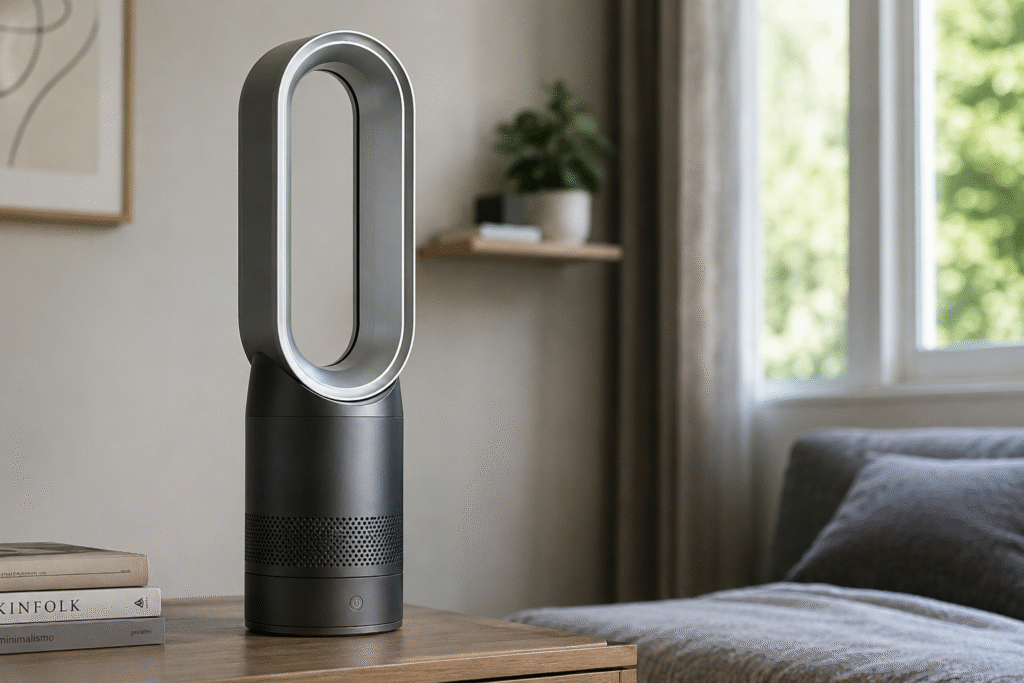
You have probably seen a Dyson fan before. Unlike a traditional fan, it has no large blades spinning in front of you. Yet, when you turn it on, it produces a strong and continuous stream of air. So, if there are no visible blades, how does a Dyson fan actually move air?
The answer lies in a combination of a high-speed motor, a specially designed impeller, and a technology called Air Multiplier. Instead of using large exposed blades to directly push air toward you, Dyson’s design pulls air into the machine and accelerates it through a carefully designed airflow path. The result is a smooth stream of air coming from the ring-shaped opening.
This design makes Dyson fans look almost futuristic, but the basic idea is still based on familiar principles of fluid dynamics and pressure. In this article, we will break down how a Dyson bladeless fan works, what happens inside the machine, why it can produce strong airflow without visible blades, and whether it is actually better than a traditional fan.
What Is a Bladeless Fan?
The term “bladeless fan” can be slightly misleading. A Dyson fan does contain a fan-like component inside it. The difference is that you cannot see the spinning blades because they sit inside the base of the machine.
A traditional fan usually has several large blades attached to a motor. When those blades rotate, they push air forward and create airflow. Dyson takes a different approach. Its visible ring does not contain the large spinning blades you would normally associate with a fan. Instead, the motor and impeller sit inside the base, where they pull air into the machine.
The air then travels through the internal structure and exits through a narrow opening around the ring. This creates a fast-moving stream of air that can feel like the airflow from a conventional fan, even though the mechanism looks completely different from the outside.
So technically, Dyson fans are not completely “bladeless.” They simply hide the main rotating component inside the base.
The Technology Behind Dyson Air Multiplier
The key technology behind Dyson’s design is Air Multiplier. Dyson developed this system to create a strong, continuous airflow using a combination of an internal impeller and carefully shaped air passages.
When you switch on the fan, a high-speed motor spins the impeller inside the base. The impeller draws surrounding air into the machine. Instead of immediately pushing that air directly toward the user, the machine guides it through an internal airflow system.
The air eventually reaches the ring-shaped part of the fan. Around this ring is a narrow slot through which the air is pushed at high speed.
This is where the interesting part happens.
As the fast-moving air travels over the surface of the ring, it helps draw additional surrounding air into the airflow. This process is related to induction and entrainment, where a moving stream of fluid influences and carries along nearby fluid.
The result is a larger overall stream of moving air than the amount of air that initially passes through the narrow opening alone. Dyson calls this effect Air Multiplier.
The important thing to understand is that the machine does not magically create extra air. It uses the movement of one stream of air to pull surrounding air into the overall flow.
What Happens Inside a Dyson Fan?
Let’s follow the air step by step.
First, the motor starts spinning the impeller inside the base. The impeller acts like a small, enclosed fan and draws air into the machine from the surrounding environment.
Next, the machine directs this air through specially designed internal passages. The shape of these passages matters because engineers need to control how efficiently air moves through the device while keeping turbulence and unwanted noise under control.
The air then travels upward toward the ring. Instead of coming out through a large opening, it passes through a relatively narrow continuous slot around the ring.
Because the opening is narrow, the air exits at high velocity. The moving air then interacts with the surrounding air, pulling more air into the stream as it travels forward.
Finally, the combined airflow moves toward the person standing in front of the fan.
From the outside, it looks as if the ring itself is producing the air. In reality, most of the important work happens inside the base and the carefully engineered air channel.
Why Doesn’t Dyson Need Large Fan Blades?
Traditional fans use large blades because they need to move a significant amount of air. The blades rotate and physically push air forward.
Dyson moves this rotating component into the base. This allows the company to make the visible part of the product much simpler. Instead of seeing a large spinning propeller, you see an open ring.
This design also gives engineers more control over the shape and direction of the airflow. Depending on the model, Dyson can combine the airflow system with oscillation and other controls to direct air around a room.
The absence of exposed blades also makes the product easier to clean compared with traditional fans that can collect dust on their blades and protective grills. It also removes the large rotating blade assembly from the area where people place their hands.
However, this does not mean the technology is automatically more efficient than every traditional fan. A conventional fan can also move a lot of air very efficiently because its large blades directly interact with the surrounding air. Dyson’s advantage comes partly from its engineering, airflow design, form factor, and additional features rather than simply from removing visible blades.
Why Is the Ring Shape Important?
The circular ring is not just there to make the fan look futuristic. Its shape plays an important role in controlling the airflow.
Inside the ring is an air channel that guides the air around the loop. A narrow outlet then directs the air along the surface of the ring and toward the front.
The engineers have to carefully design the shape of this channel and outlet. Small changes can affect air velocity, pressure, turbulence, and noise.
This is a common idea in engineering. A machine may look simple from the outside, but the shape of its internal components can require a significant amount of testing and optimization.
Dyson has used computational fluid dynamics, prototyping, and extensive testing to study how air behaves inside and around its products. Engineers can model airflow digitally before building physical prototypes, then test those designs in the real world.
Why Does the Airflow Feel Smooth?
One noticeable difference between many traditional fans and Dyson’s design is the way the airflow feels.
A traditional fan has rotating blades. As each blade moves through the air, it creates changes in pressure and airflow. This can produce the familiar pulsing sensation that you sometimes feel when sitting directly in front of a fan.
Dyson’s design aims to create a more continuous stream of air. Since the airflow exits through a continuous slot around the ring, the resulting stream can feel smoother and more consistent.
That does not mean every Dyson model will feel completely different from every conventional fan. Different fan designs, speeds, room conditions, and airflow settings can produce very different experiences.
Still, controlling the airflow rather than simply exposing a large rotating propeller is an important part of Dyson’s engineering approach.
Does a Dyson Fan Actually Multiply Air?
This is one of the biggest questions people have about the name Air Multiplier.
The fan does not create additional air from nothing. That would violate the basic laws of physics.
Instead, the term describes how the high-speed primary airflow interacts with surrounding air. The fast-moving air encourages additional surrounding air to join the stream. This increases the total volume of air moving in the resulting airflow.
Think about what happens when you move quickly through water. Your movement does not create more water, but it affects the water around you and causes it to move as well.
A similar principle applies to the airflow around the Dyson ring.
So when Dyson talks about multiplying airflow, it refers to the way the device uses a relatively controlled primary air stream to entrain surrounding air and produce a larger overall airflow.
What Makes Dyson Fans Different From Normal Fans?
The biggest difference is not simply the absence of visible blades. It is the way the entire airflow system is designed.
A conventional fan generally uses a motor and exposed blades to move air directly. The design is relatively straightforward and can provide strong airflow at a relatively low price.
A Dyson fan combines an enclosed motor and impeller with carefully engineered air passages, a ring-shaped outlet, airflow control, and, depending on the model, additional technologies such as air-quality sensors and purification systems.
Some Dyson air treatment products can also monitor particles or gases in the surrounding air and automatically adjust their operation. This turns the device from a simple fan into a more complicated piece of home technology.
That additional engineering is also one reason Dyson products tend to cost significantly more than basic household fans.
Why Are Dyson Fans So Expensive?
A Dyson fan can cost many times more than a conventional fan, which naturally raises the question: what are you actually paying for?
Part of the price comes from engineering and product development. Dyson invests heavily in research, testing, motors, airflow systems, sensors, electronics, and industrial design.
The company also builds its products around compact components and specialized airflow systems rather than relying on a simple motor-and-blade design.
Some models include additional features such as remote controls, automatic temperature or airflow adjustments, air-quality monitoring, heating, cooling, or air purification.
There is also the cost of the Dyson brand itself. Like many premium technology companies, Dyson charges a premium for its design, engineering, features, and brand positioning.
However, expensive does not always mean universally better. If your only goal is to move air around a room as cheaply as possible, a conventional fan can often do that perfectly well. Dyson becomes more interesting if you value its design, compact form, airflow control, quieter operation, or additional smart features.
Is a Dyson Fan Really Better?
The answer depends on what you expect from a fan.
If you want an affordable way to cool yourself on a hot day, a normal fan can be extremely effective. It uses a simple mechanism, consumes relatively little electricity, and is easy to repair or replace.
Dyson’s advantage comes from combining airflow engineering with design and technology. The enclosed impeller creates the distinctive bladeless appearance, while advanced models can add sensors, automatic controls, heating, cooling, and purification.
The bladeless design can also make cleaning easier because you do not have large exposed fan blades collecting dust.
But Dyson fans also have disadvantages. They cost more, and the complex electronics and motor system can make them more expensive to repair. The “bladeless” design also does not mean that the machine uses no rotating parts or that it automatically moves more air than a traditional fan.
In other words, Dyson has not completely reinvented the laws of airflow. It has engineered a familiar concept into a very different product.
Where Else Is This Technology Used?
The ideas behind Air Multiplier are not limited to desk or tower fans.
Dyson has incorporated similar airflow principles into several of its air treatment products, including devices designed for heating, cooling, and air purification.
This makes the technology particularly interesting because the same basic airflow architecture can support different functions. For example, a device can pull air through filters, move that air through internal channels, and then distribute it around a room.
The engineering challenge changes depending on the product. A purifier has to consider filtration and particle removal, while a heater must deal with heat transfer and temperature control. A fan focuses more heavily on moving air efficiently and comfortably.
The underlying lesson is that good engineering often comes from controlling something as ordinary as airflow in a very precise way.
What Can Students Learn From Dyson?
Dyson is a great example of how engineering can transform an everyday object.
A fan is not a new invention. Humans have been using mechanical fans for a very long time. Dyson’s approach shows that innovation does not always mean inventing something that has never existed before.
Sometimes, innovation means taking an existing product and asking better questions.
Can the airflow be controlled differently? Can the motor be placed somewhere else? Can the product become easier to clean? Can sensors make it smarter? Can the design become smaller or safer?
These questions combine several areas of engineering, including mechanical engineering, fluid dynamics, electronics, materials science, software, and industrial design.
For students interested in technology, this is an important lesson. You do not always need to invent an entirely new category of product. You can take something people have used for decades and find a better way to design it.
The Future of Smart Airflow
Fans are becoming more than simple machines that turn on when you press a button.
Modern air treatment devices can include sensors that monitor temperature, humidity, particles, and other aspects of indoor air. Software can then use this information to automatically change fan speed or operating modes.
This trend is part of a larger shift toward smart home technology, where everyday appliances collect information about their surroundings and adjust their behavior automatically.
In the future, airflow devices could become even more adaptive. Instead of manually selecting a speed, a device could continuously monitor a room and optimize its operation based on temperature, air quality, occupancy, and energy consumption.
The technology behind a Dyson fan therefore represents more than a clever-looking product design. It shows how engineering, sensors, software, and physics can come together to improve something as simple as moving air.
Final Thoughts
A Dyson bladeless fan may look like it has removed one of the most important parts of a fan: the blades. But the blades have not disappeared completely. Dyson simply moved the rotating impeller inside the base and redesigned the way air travels through the machine.
The motor pulls air into the device, the impeller accelerates it, and carefully shaped internal passages guide it toward the ring. A narrow outlet then produces a fast-moving stream of air that entrains surrounding air, creating the larger airflow associated with Dyson’s Air Multiplier technology.
The real innovation is therefore not that Dyson discovered a way to create air without blades. It is that the company redesigned a familiar machine around airflow control, compact engineering, and modern electronics.
And that is what makes the Dyson fan an interesting piece of technology. Something as ordinary as a fan can become a surprisingly complex engineering problem when you start asking one simple question: “Is there a better way to move air?”