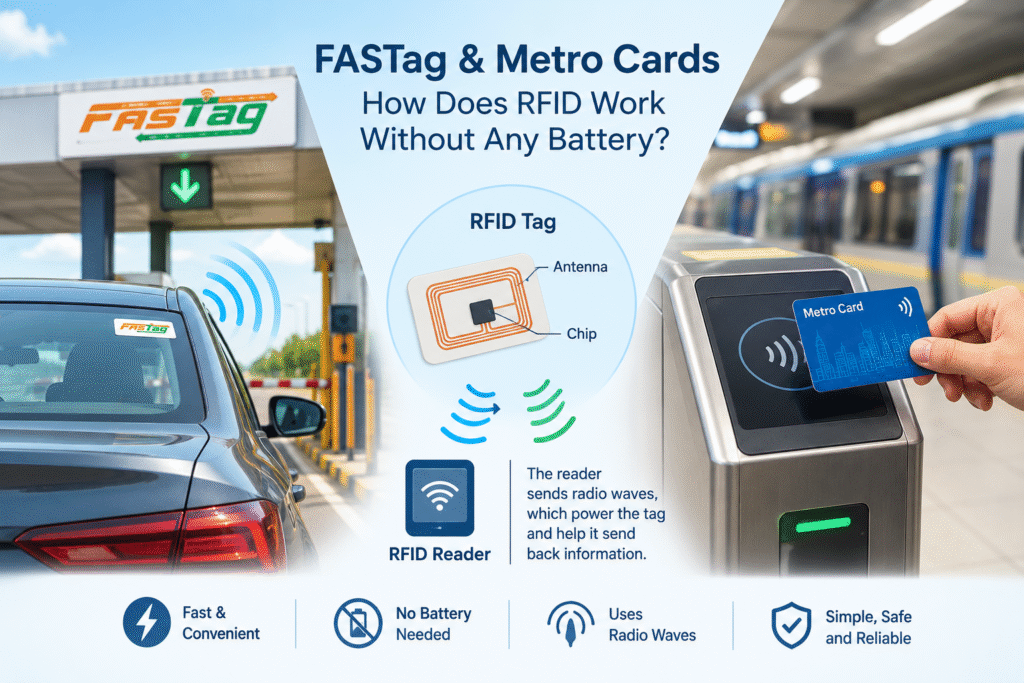
You probably use RFID technology more often than you realize. You drive through a FASTag lane at a toll plaza and the barrier opens automatically. You tap your metro card against a reader and hear a beep before entering the station. There is no cable connecting your card to the machine, no battery inside your FASTag, and no complicated process that you need to follow. Everything happens in just a few seconds.
But this raises an interesting question: if a FASTag or metro card doesn’t have a battery, how does it communicate with a reader? How does the machine recognize your card? And how can a tiny chip send information without having its own power source?
The technology behind this is called RFID, or Radio Frequency Identification. RFID allows devices to identify and exchange information using radio waves. One of the most interesting forms of RFID is passive RFID, where the tag doesn’t need its own battery. Instead, the RFID reader provides the energy required for the tag to temporarily power itself and communicate.
This technology might sound complicated, but the basic idea is surprisingly simple.
What Is RFID?
RFID stands for Radio Frequency Identification. It is a technology that uses radio waves to identify objects or devices that contain a small electronic tag. An RFID system generally has two main components: an RFID reader and an RFID tag.
The reader is the device that sends and receives radio signals. You can find RFID readers at toll plazas, metro stations, office entrances, warehouses, stores, and many other locations. The RFID tag is the small electronic component attached to or embedded inside the object that needs to be identified.
A FASTag is one example of an RFID tag. It is attached to the windshield of a vehicle and can be detected by an RFID reader installed at a toll plaza. Similarly, many contactless cards used in transportation systems rely on radio-frequency technology to communicate with a reader when the card is brought close to it.
The interesting part is that some RFID tags don’t require a battery at all. These are known as passive RFID tags.
How Does RFID Work Without a Battery?
This is the most interesting part of the technology.
If an RFID tag doesn’t contain a battery, it still needs some form of energy to operate its electronic components. Instead of carrying its own power source, a passive RFID tag gets energy from the RFID reader.
When the tag comes close to the reader, the reader generates an electromagnetic field. The antenna inside the RFID tag interacts with this field and receives energy from it. That energy is converted into enough electrical power to temporarily activate the tiny chip inside the tag.
The tag can then process information and communicate with the reader.
Once the tag moves away from the reader, it no longer receives enough energy to operate. It doesn’t need to remain powered because it only needs to become active when it is close to an RFID reader.
This is one of the reasons passive RFID is so useful. A tag can remain inactive for a long time and doesn’t need to be recharged or have its battery replaced.
What Is Inside an RFID Tag?
An RFID tag may look like a simple sticker or plastic card, but there is some interesting technology hidden inside it. A typical passive RFID tag contains an antenna and a tiny integrated circuit, or chip.
The antenna is responsible for interacting with the radio-frequency signal from the reader. It can collect energy from the electromagnetic field and also participate in communication between the tag and reader.
The chip contains the information that allows the system to identify the tag. Depending on the application, this information can be associated with a vehicle, card, product, access credential, or another object.
Because the components are extremely small and consume very little power, they can be embedded into thin cards, stickers, labels, and other objects without requiring a conventional battery.
How Does FASTag Work?
Now let’s look at something millions of people encounter on Indian roads: FASTag.
FASTag is an electronic toll collection system that uses RFID technology to identify vehicles at toll plazas. The RFID tag is attached to the vehicle’s windshield and is associated with the relevant FASTag account.
When a vehicle approaches a FASTag-enabled toll lane, an RFID reader installed at the toll plaza communicates with the tag. The reader sends a radio-frequency signal, which allows the tag to respond with the information needed to identify it.
The toll collection system can then use this information to process the applicable toll transaction through the account associated with the FASTag.
From the driver’s perspective, the process is extremely simple. You slow down and drive through the designated lane, the system detects the FASTag, the toll is processed, and the barrier opens if everything is successful.
What makes this interesting is that the FASTag itself doesn’t need a battery to communicate with the reader. The RFID infrastructure at the toll plaza provides the energy needed for the passive tag to operate.
What Happens When You Drive Through a FASTag Lane?
Let’s break the process down into a simple sequence.
First, your vehicle approaches the toll plaza with the FASTag attached to its windshield. The RFID reader installed at the toll lane continuously sends out a radio-frequency signal.
As your FASTag comes within the reader’s effective range, the antenna inside the tag receives energy from the electromagnetic field. This provides enough power for the chip inside the tag to become active.
The tag then communicates information back to the reader. The toll system identifies the FASTag and connects that information with the corresponding account. The applicable toll amount can then be processed through the payment system associated with the FASTag.
Once the transaction is successfully completed and the system confirms that the vehicle can pass, the toll barrier opens.
The entire process can happen extremely quickly. You don’t need to stop and hand over cash, enter a PIN, scan a QR code, or physically connect anything to the toll machine.
How Do Metro Cards Work?
Metro cards use a similar contactless communication concept, although the exact technology and implementation can vary between different metro systems.
When you bring a contactless metro card close to a compatible reader, the reader generates an electromagnetic field. The antenna inside the card interacts with this field and receives enough energy to activate its chip.
The card and reader then communicate wirelessly over a short distance. The transportation system can use the card’s information to determine whether the card is valid and process the required entry or exit transaction.
You simply tap the card, the reader detects it, the system processes the information, and the gate opens if the transaction is successful.
There is no need for the card to contain a conventional battery because the reader provides the energy required during the short interaction.
How Does the RFID Reader Give Power to the Card?
The answer lies in electromagnetism.
When electrical current flows through a conductor, it can create a magnetic field. RFID readers use antennas designed to generate electromagnetic fields at particular radio frequencies.
When a compatible passive RFID tag enters this field, its antenna interacts with the electromagnetic energy. The tag can capture some of that energy and convert it into electrical power.
The amount of energy involved is tiny, but the electronic circuitry inside the tag is also designed to consume very little power. This allows the tag to temporarily operate without having a battery.
You can think of it as the RFID reader briefly providing the tag with the energy it needs to “wake up.”
This concept is somewhat similar to wireless charging in the sense that energy is transferred without a physical cable. However, passive RFID isn’t simply wireless charging. The tag is not storing energy in a battery; it is harvesting enough energy from the reader’s signal to operate and communicate.
How Does the Tag Send Information Back?
Receiving energy is only half of the process. The tag also needs to communicate information back to the reader.
Passive RFID systems can use a technique called backscatter communication. Instead of generating a strong radio signal using its own power source, the tag can modify the way it interacts with the signal being transmitted by the reader.
These changes affect the signal reflected back toward the reader. The reader detects those changes and interprets them as information.
In simple terms, the RFID tag is able to communicate by manipulating the signal provided by the reader rather than needing a battery-powered radio transmitter of its own.
This is one of the cleverest aspects of passive RFID technology. A tiny electronic tag can communicate with a reader even though it doesn’t contain a traditional power source.
Why Don’t FASTags and Metro Cards Need Batteries?
The biggest advantage of a battery-free RFID tag is simplicity.
Imagine if every metro card required a battery. Eventually, that battery would run out and the card would need to be recharged or replaced. The same problem would apply to RFID tags used for access cards, inventory labels, and other applications.
Passive RFID eliminates this problem because the tag doesn’t need to remain powered. It only becomes active when it is close enough to a reader.
This also allows RFID tags to be extremely thin, lightweight, and relatively inexpensive to manufacture. A card can sit inside your wallet for months without being used and still work when you finally tap it against a compatible reader.
For systems that need millions of cards or tags, not having to maintain millions of batteries is a major advantage.
Why Does RFID Have a Limited Range?
You might wonder why you can’t simply keep your metro card several metres away from the reader and expect it to work.
The answer is related to how passive RFID receives its power. The farther a tag is from the reader, the weaker the electromagnetic field available to it becomes. At some point, the tag won’t receive enough energy to operate reliably.
The exact range depends on the type of RFID technology, frequency, reader, antenna, and environment being used.
A relatively short range can actually be useful. A metro gate needs to identify the card being presented to it rather than accidentally communicating with every card several metres away. Similarly, a toll system needs to identify the relevant FASTag as the vehicle passes through a particular lane.
The limited range helps create a controlled interaction between the reader and the tag.
RFID vs Bluetooth: What’s the Difference?
Because both RFID and Bluetooth use wireless communication, it is easy to assume that they work in the same way. They don’t.
Bluetooth devices generally have their own power source and are designed for longer-duration wireless communication. Your wireless headphones, for example, contain a battery because they need to maintain an active connection with your phone.
Passive RFID tags work differently. They can receive energy from the reader and use that energy to communicate for a short period of time. They don’t need to maintain a continuous connection like Bluetooth devices.
This is why you don’t have to pair a FASTag with a toll machine or connect your metro card to a reader before using it. You simply bring the tag within the reader’s operating range and the interaction happens automatically.
Where Else Is RFID Used?
FASTags and metro cards are only two examples of RFID technology. RFID is used in many industries because it provides a convenient way to identify objects without requiring a physical connection.
One common application is access control. Offices, universities, hotels, and other buildings can use RFID-enabled cards or badges to determine whether someone is authorized to enter a particular area.
RFID is also widely used in inventory management and logistics. Products can be given RFID tags so that warehouses can identify and track large numbers of items efficiently. Unlike a traditional barcode, an RFID tag doesn’t necessarily have to be visually visible to the reader, depending on the particular system.
Retail stores can use RFID to track products, while libraries can use RFID tags to identify books. Hospitals and other organizations can also use RFID for tracking equipment and supplies.
The applications are different, but the underlying idea remains the same: use radio waves to identify and communicate with a tagged object.
RFID vs QR Codes
RFID and QR codes are both commonly used for identification and transactions, but they work in completely different ways.
A QR code is an optical technology. A camera or scanner needs to visually detect the pattern and decode the information stored in it. RFID, on the other hand, uses radio waves to communicate with an electronic tag.
This is why you don’t need to point your phone’s camera at a FASTag or tap a QR code against a metro reader. The RFID system handles the communication wirelessly.
QR codes can be extremely useful because they are cheap and easy to create, while RFID can provide fast, contactless identification without requiring a camera to visually scan a code.
What Are the Advantages of RFID?
RFID provides several advantages that make it useful in everyday technology.
The first is convenience. RFID allows objects to be identified without requiring physical contact between the tag and reader. This is why you can simply drive through a FASTag lane or tap a metro card against a reader.
The second is speed. RFID interactions can happen very quickly, which is important in systems where large numbers of vehicles or people need to be processed. A toll plaza, for example, cannot afford to spend several minutes processing every vehicle.
Another advantage is that passive RFID tags don’t require batteries. This makes them lightweight, low-maintenance, and suitable for large-scale applications where replacing or charging batteries would be impractical.
RFID tags can also be embedded into many different objects, including cards, stickers, labels, and access badges. This allows the technology to operate quietly in the background without requiring users to understand how it works.
Are There Any Limitations to RFID?
Like every technology, RFID also has limitations.
Passive RFID tags have a limited range because they depend on energy from the reader. Their performance can also be affected by the surrounding environment and the materials they are placed near. Metals and liquids, for example, can create challenges for certain RFID systems.
Security is another important consideration. RFID systems need to be designed properly to prevent unauthorized reading, copying, or misuse of information. The security features can vary significantly depending on the specific RFID technology and application.
It is also important to remember that the RFID tag itself is only one part of a much larger system. The tag may simply contain an identifier, while the actual account information and transaction processing happen elsewhere. Securing an RFID-based system therefore involves protecting the tag, reader, communication system, and backend infrastructure.
Why Is RFID So Useful for Transportation?
Transportation is one of the areas where RFID makes particularly good sense.
Think about the number of vehicles passing through a toll plaza every day or the number of passengers entering a busy metro station. Manually checking tickets or processing cash for every person and vehicle would take a significant amount of time.
RFID allows these interactions to become almost automatic. A vehicle can be identified while passing through a toll lane, and a passenger can tap a card against a reader without physically inserting anything into a machine.
The technology works especially well in these situations because the interaction needs to be fast, contactless, and reliable.
The Technology Working in the Background
One of the most interesting things about RFID is that most people don’t even notice it.
You don’t think about electromagnetic fields when you drive through a toll plaza. You don’t think about radio waves when you tap your metro card. You simply see the barrier open or hear a small beep from the reader.
But behind that simple interaction is a combination of electromagnetism, radio communication, electronic circuits, software, and payment infrastructure.
A tiny RFID tag can receive energy from a reader, use that energy to activate its chip, and communicate information back to the reader — all without carrying its own battery.
What Could the Future of RFID Look Like?
RFID is already being used across transportation, retail, logistics, access control, and many other industries. As more physical objects become connected to digital systems, technologies that can identify objects without requiring wires or batteries could become even more useful.
The idea of battery-free communication is particularly interesting because not every connected object needs a powerful processor or a large battery. Some objects simply need to identify themselves or communicate a small amount of information when they come close to a reader.
This could make RFID useful in increasingly automated environments where machines need to identify products, vehicles, people, or equipment without requiring manual input.
So, How Does RFID Work Without a Battery?
The answer is simpler than it first appears.
The RFID reader provides the energy. The tag captures that energy through its antenna, uses it to activate its chip, and communicates information back to the reader.
That’s how a FASTag can be detected at a toll plaza without a battery. That’s how a compatible contactless metro card can communicate with a reader when you tap it. And that’s why an RFID tag can remain inactive for months or years and still work when it comes close to the right reader.
The next time you drive through a FASTag lane or tap your metro card, remember that you’re seeing a surprisingly clever piece of technology in action. There may be no battery, no cable, and no visible connection between the card and the machine — yet in a fraction of a second, energy and information are exchanged using radio waves.
What looks like a simple tap or drive-through is actually a small example of wireless communication, electromagnetic energy transfer, and computing working together.